Straddle vs Strangle in Options Trading
Options trading strategies like straddle and strangle are widely used in the stock market, especially during events like RBI policy, budget announcements, or earnings results.
Both strategies are designed to benefit from volatility, but they work differently. In this guide, we will break down straddle vs strangle in a simple way.
What is a Straddle Strategy?
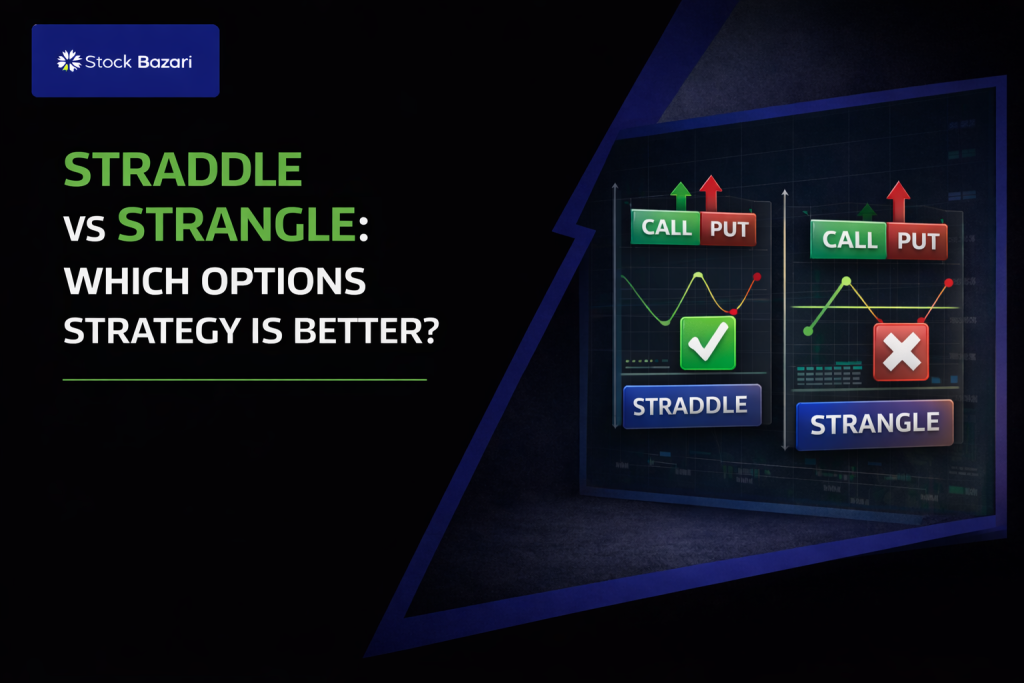
A straddle strategy involves buying or selling both a call option (CE) and a put option (PE) at the same strike price.
Example (Long Straddle):
Nifty at 22,000
- Buy 22,000 CE
- Buy 22,000 PE
Use when: You expect a big move but don’t know the direction
Risk: Premium paid (in buying)
Reward: Unlimited if a strong move happens
What is a Strangle Strategy?
A strangle strategy involves buying or selling call and put options at different strike prices.
Example (Long Strangle):
Nifty at 22,000
- Buy 22,200 CE
- Buy 21,800 PE
Use when: Expect volatility but want lower cost
Risk: Lower premium than straddle
Reward: Requires a bigger move to profit
Key Differences Between Straddle and Strangle
| Feature | Straddle | Strangle |
| Strike Price | Same | Different |
| Break-even | Closer | Wider |
| Risk | Higher premium | Lower premium |
| Profit Potential | High | Needs a bigger move |
When to Use Each Strategy
Use Straddle when:
- The big event is near
- High volatility expected
- You want a quicker breakout
Use Strangle when:
- Moderate volatility expected
- You want a cheaper strategy
- You are okay with a wider range
Pros and Cons
Straddle – Advantages & Disadvantages
Advantages:
- Quick profit on a strong move
- Balanced risk on both sides
Disadvantages:
- High premium cost
- Time decay is faster
Strangle – Advantages & Disadvantages
Advantages:
- Lower cost
- Lower risk compared to straddle
Disadvantages:
- Needs a larger move
- Slower profit potential
Risk Management Tips
- Avoid holding till expiry without a plan
- Use a stop-loss on the premium
- Monitor volatility (IV)
- Do not trade blindly during news events
Options strategies require discipline and planning.
Conclusion
Both straddle and strangle are powerful strategies for trading volatility.
If you want faster results and can afford a higher premium, go for a straddle. If you want a lower-cost approach, strangle is better.
There is no perfect strategy — choose based on market conditions and your risk appetite.