Debt vs Equity: Key Differences Explained
When analyzing a company, one of the most important concepts is understanding debt and equity.
These two sources of funding play a major role in a company’s financial health and growth.
Let’s break it down in a simple and practical way.
What is Debt?
Debt is money borrowed by a company from banks, financial institutions, or other sources.
This money must be:
- Repaid over time
- Paid with interest
Examples of debt include:
- Bank loans
- Bonds
- Debentures
Debt increases financial obligations for the company.
What is Equity?
Equity represents ownership in a company.
When investors buy shares, they become partial owners of the company.
Equity does not need to be repaid, but:
- Profits are shared with shareholders
- Ownership is diluted
Equity funding is more flexible compared to debt.
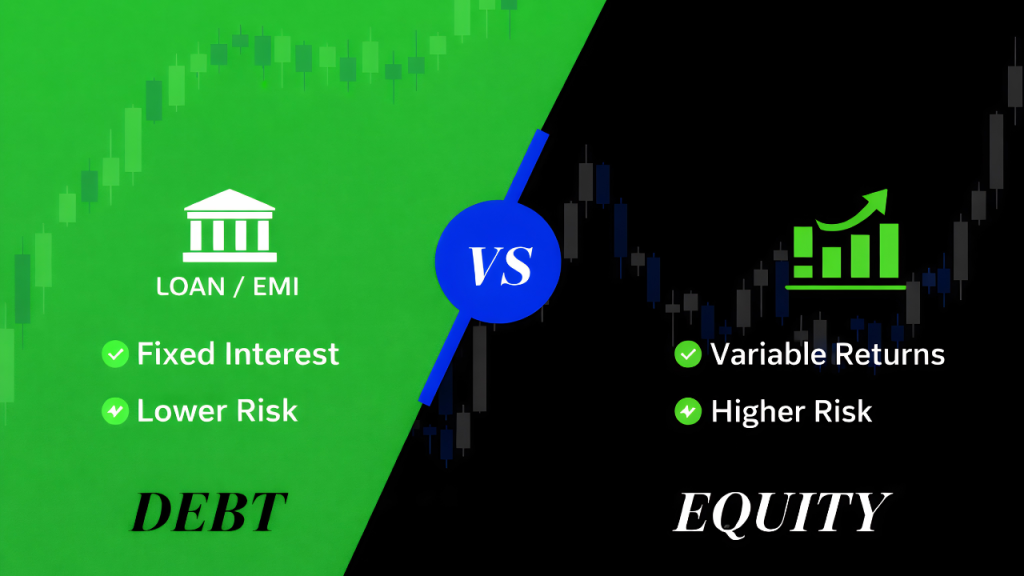
Debt vs Equity: Key Differences
Let’s understand the major differences.
Ownership
- Debt → No ownership given
- Equity → Ownership is shared
Equity investors become part owners of the business.
Risk
- Debt → Fixed repayment obligation (higher risk for company)
- Equity → No fixed repayment (lower financial pressure)
High debt increases risk during downturns.
Cost
- Debt → Interest payments required
- Equity → Profit sharing instead of fixed cost
Debt can become expensive if interest rates rise.
Impact on Company
- Debt → Can boost growth but increases risk
- Equity → Safer but may dilute control
A balanced mix is usually preferred.
Debt vs Equity Ratio Explained
The debt-to-equity ratio helps measure a company’s financial leverage.
Formula:
Debt-to-Equity Ratio = Total Debt / Total Equity
Interpretation:
- Low ratio → Safer, less debt
- High ratio → Higher risk
Investors often prefer companies with low or manageable debt levels.
Which is Better for Investors?
There is no simple answer.
Debt is good when:
- Used for productive growth
- Managed efficiently
Equity is better when:
- Company maintains stability
- Growth is sustainable
Ideal Scenario:
Companies with:
- Low or controlled debt
- Strong equity base
- Consistent growth
These are considered high-quality investments.